客户大老远跑来一趟,看的从来不只是几件工作服
European Customers Visit Our Workwear Factory: Quality You Can See, Production You Can Trust
When a customer travels thousands of kilometers to visit a factory, they are usually not coming just to look at a few machines or take some photos.
They want to know one thing:
**Can this factory become a reliable long-term manufacturing partner?**
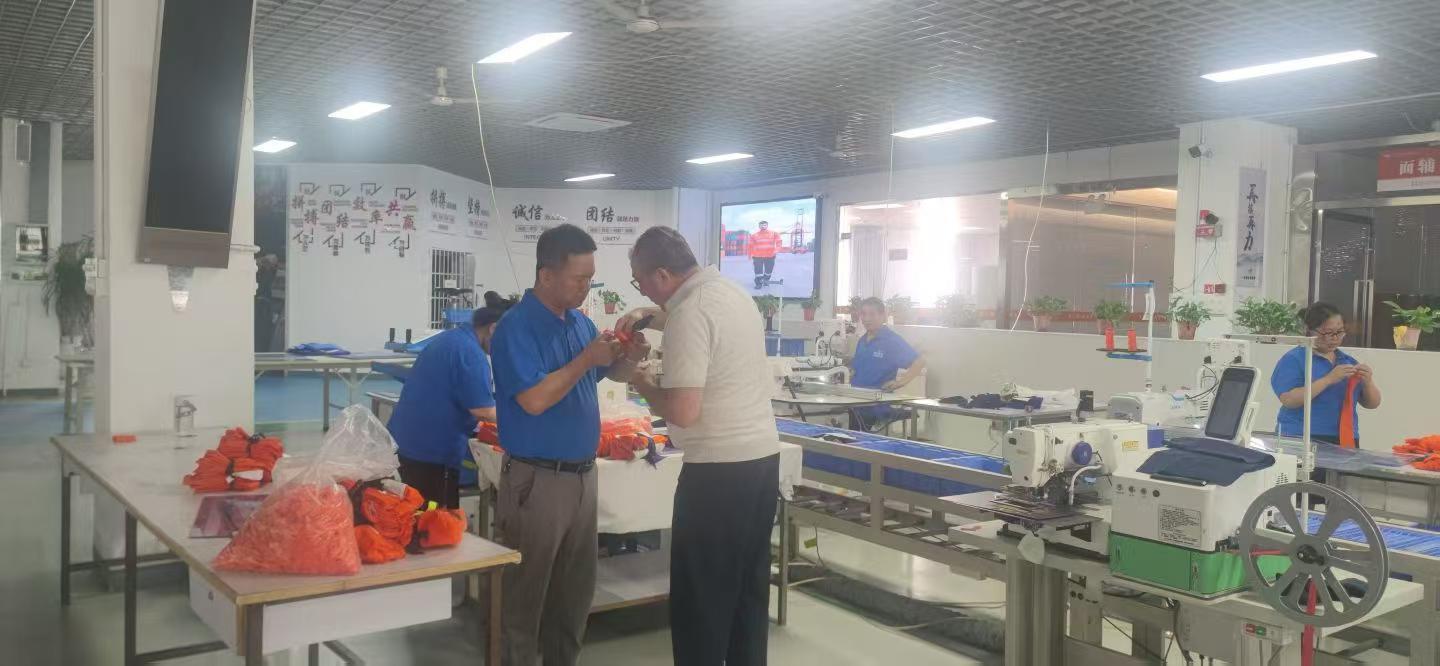
Recently, we welcomed European customers to our workwear factory in China. During the visit, they carefully reviewed our entire production process, from fabric cutting and color-shading control to sewing, template machines, finishing, inspection, and sample approval.
Instead of simply walking through the workshop, they took time to examine how each production stage was managed.
For us, this was not a specially prepared presentation.
It was simply another normal production day.
### The Factory Tour Started with Cutting, Not the Meeting Room
One of the first areas our customers visited was the cutting department.
For workwear manufacturing, cutting may look like a basic process, but it has a major influence on the final garment quality.
When producing large quantities of workwear, especially for export markets, consistency matters.
Different fabric batches, cutting directions, or handling methods may result in slight shade variations. These differences might not always be obvious when looking at one garment, but they can become noticeable when hundreds or thousands of pieces are produced together.
That is why color-shading control is an important part of our production management.
Before bulk sewing begins, our team carefully checks the fabric, organizes cutting sections, and manages garment panels according to production requirements.
For us, quality control does not begin at the final inspection table.
It begins before the first piece of fabric is cut.
### Small Production Details Often Tell Customers the Most
After visiting the cutting area, the customers continued to the sewing workshop.
Machines were running, workers were handling current orders, and production was moving according to schedule.
One area that attracted particular attention was our use of sewing templates and specialized machines.
Why are these machines important?
Because they help improve production consistency.
Traditional sewing depends heavily on the skill and experience of individual workers. Experienced operators can produce excellent results, but when a large order involves many workers, small differences in sewing position, dimensions, pocket placement, and stitching may appear.
Templates and specialized equipment help reduce these variations.
For example, certain pocket positions, repeated stitching processes, and fixed-size construction details can be completed more consistently with the assistance of standardized equipment.
This is especially important for OEM and ODM workwear production.
A customer does not only want one excellent sample.
They want thousands of garments to remain as close as possible to the approved sample.
### Making One Good Sample Is Easy. Keeping Bulk Production Stable Is Harder.
After more than 20 years in workwear manufacturing, we have learned that customers usually become more focused on consistency as cooperation develops.
At the beginning, they may ask about price, fabrics, delivery times, production capacity, or certificates.
But eventually, the most important question becomes:
**Will the bulk production match the approved sample?**
This is why our European customers followed the production process from beginning to end.
They checked sewing quality, garment construction, production methods, and finishing details.
For workwear orders, many small details matter:
Are the pockets positioned correctly?
Are the seams clean and consistent?
Are the garment measurements stable?
Are the specified fabrics and accessories being used?
Are reflective materials, zippers, Velcro, and other components installed according to the approved requirements?
When thousands of garments are produced, even a small production inconsistency can become a serious issue.
For this reason, we do not rely only on final inspection.
Quality control is integrated throughout the production process.
Whenever possible, problems are identified and corrected at the stage where they occur.
This helps reduce rework, protect delivery schedules, and improve overall production stability.
### Customers Want to See the Entire Process
After sewing, the customers visited the finishing area.
At this stage, the garments are nearly complete, but several important steps still remain.
Loose threads, appearance, dimensions, cleanliness, finishing quality, labeling, folding, and packaging all need to be checked before shipment.
For export orders, this stage is especially important.
Once the garments leave the factory, they may travel thousands of kilometers through transportation, warehousing, distribution, and finally reach the end customer.
If a problem is discovered after delivery, the cost of communication and correction becomes much higher.
That is why we prefer to identify potential issues inside the factory instead of leaving them for the customer.
During the visit, our European customers were able to see the complete workflow, from cutting and sewing to finishing and inspection.
After reviewing the production process, they gave positive feedback on our factory management and manufacturing standards.
For our team, that recognition means a lot.
Because they were not only evaluating the final garment.
They were evaluating the system behind it.
### Sample Approval Was One of the Most Important Moments
After the production tour, we moved on to sample review and approval.
For customized workwear, especially OEM and ODM projects, samples are one of the most important communication tools between the factory and the customer.
Technical drawings, measurement charts, and specification sheets are important, but the physical sample shows the real result.
The customer can check the fit, fabric, workmanship, garment structure, accessories, and overall appearance directly.
During this visit, our customers carefully reviewed the samples on site.
Questions were discussed face to face, details were confirmed immediately, and any necessary adjustments could be communicated efficiently.
The customers were pleased with the sample quality and gave us very positive feedback.
For our production team, seeing a customer approve a sample is always rewarding.
Behind every approved sample are the efforts of the sales team, technicians, pattern makers, sourcing staff, sewing workers, and quality-control team.
### A Factory Should Not Need to Prepare for a Customer Visit
Some people ask whether a factory feels nervous when overseas customers come for an inspection.
Our view is simple.
The best preparation for a factory visit is good daily management.
Production standards cannot be created overnight.
Stable quality cannot be achieved by preparing a few perfect samples before a customer arrives.
What really gives customers confidence is seeing a factory operating normally:
Workers following production procedures.
Machines running as expected.
Orders moving through the production line.
Quality inspections being performed.
Problems being recorded and corrected.
Each department understanding its responsibilities.
These everyday details are what truly show the strength of a manufacturing company.
### Why Do European Customers Travel So Far to Visit a Factory?
For overseas buyers, selecting a supplier is not only about purchasing garments.
It is about building a stable supply chain.
If a supplier is reliable, cooperation becomes easier over time.
If production quality is unstable, communication is poor, or delivery schedules are unpredictable, the customer must spend much more time managing the supplier.
That is why many serious buyers still prefer to visit factories in person.
They want to understand the people, equipment, production process, quality system, and management behind the product.
In other words, they are looking for confidence.
They want to know whether the factory can support their business not only for one order, but for future orders as well.
### Long-Term Cooperation Is Built Inside the Workshop
At the end of the visit, we sat down with our customers to discuss products, specifications, samples, and future cooperation.
What impressed us most was not simply the positive feedback.
It was the fact that the customers had seen the entire manufacturing process with their own eyes.
A factory does not always need complicated explanations.
The cutting table speaks for itself.
The sewing line speaks for itself.
The production equipment speaks for itself.
The inspection process speaks for itself.
And the finished garment speaks for itself.
For customers who understand manufacturing, many answers can be found simply by walking through the workshop.
For more than 20 years, we have focused on workwear manufacturing and export production.
We provide OEM and ODM services for overseas customers, including customized workwear, safety clothing, high-visibility garments, and other professional workwear products.
From one sample to bulk production, and from the first order to long-term cooperation, our goal remains the same:
**Make the product properly, manage the process carefully, and protect the trust our customers place in us.**
When customers travel thousands of kilometers to visit our factory, we see it as a sign of trust.
And the best way to respond to that trust is not with promises.
It is with stable production, visible quality, and reliable products.
